

The Loop Matters More Than the Model
Judge an AI-assisted workflow by its inspection, testing, repair, and escalation, rather than expecting a raw model response to carry the whole assurance burden.
Ask a model for code, a test, or a plan, and it may return a plausible answer with an incorrect assumption. Accepting it without checking is a mistake. Treating that one response as the complete test of AI-assisted engineering is a mistake too.
The useful unit to evaluate is the workflow around the model: what gets inspected, what gets tested, what gets repaired, and when a person needs to decide.
I call the layered version of that work compound assurance.
Give each check a job
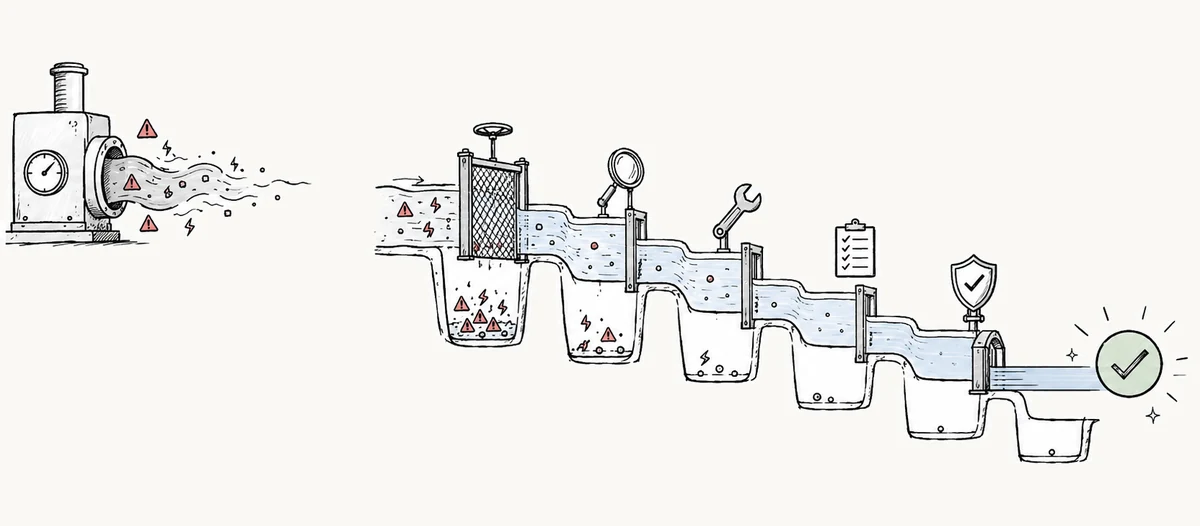
A first output is the beginning of a process. Inspection can ask whether it meets the request. Tests can exercise its behaviour. Another review can look for missing edge cases, unsafe assumptions, or departures from the team's standards.
Those checks need different purposes. Asking the same model the same question twice may reproduce the same confident error. A reviewer agreeing with the author isn't evidence that the result has been tested.
For a hypothetical code change, the checks might include comparing the implementation with the acceptance criteria, exercising the changed behaviour, and inspecting the permissions it introduces. Each examines something the others could miss.
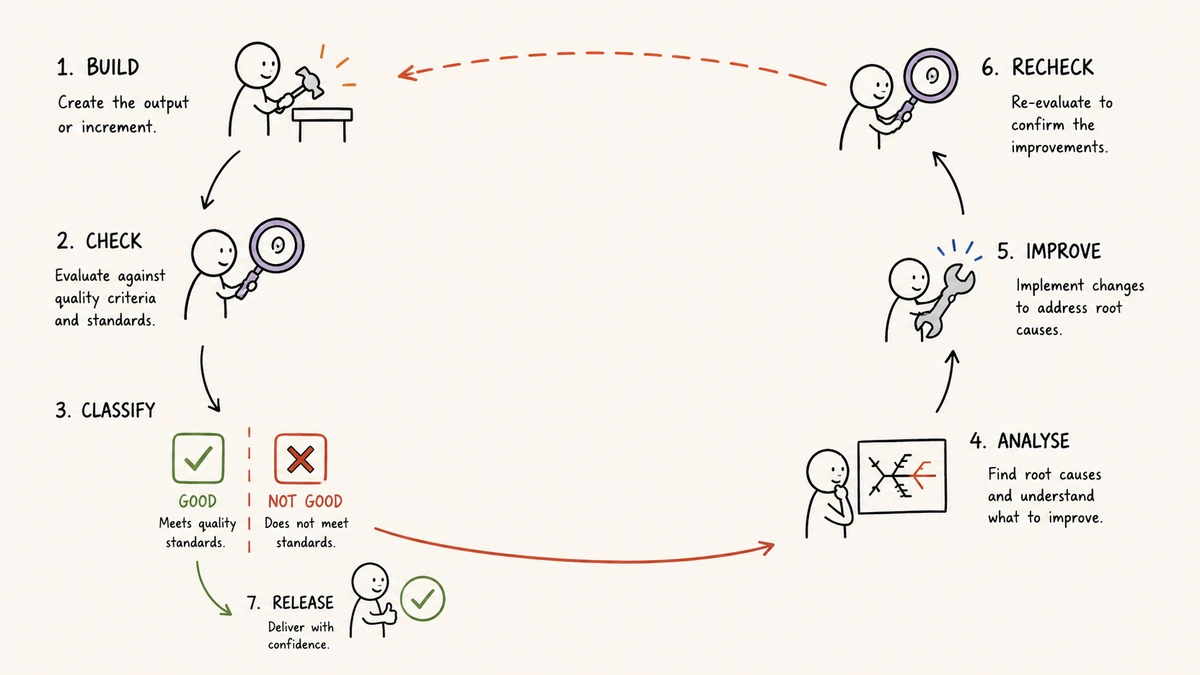
When a check finds a defect, repair it and rerun the relevant checks. Otherwise, the assurance describes an earlier version of the work.
The arithmetic needs evidence
In the video, I use a simple illustration: suppose an initial process makes errors in ten per cent of cases, and a checking stage catches ninety per cent of those errors. One per cent of the original cases would still contain a surviving error.
That is conditional arithmetic, not a measured reliability claim about a model or a promise about an agent workflow.
A further check only reduces the remaining errors to the extent that it actually detects them. Checks can share blind spots. Their effectiveness can change with the task, the inputs, or the kind of failure left over from the previous stage.
The practical lesson is to test the checking process too. Use known failures. Look at what escaped. Find out whether a supposedly different review is adding useful evidence.
Design for escalation as well as repair
A loop also needs a way to stop. Some failures need another attempt; others need a person to clarify the requirement, accept a trade-off, or refuse an action.
That means deciding in advance what the system can repair on its own, what evidence it must retain, and which decisions remain human. Endless iteration isn't assurance. It can simply be an expensive way to avoid admitting that the task is unclear.
You can carry out this work manually or organise it through agents and structured workflows. The tool doesn't remove the need to make those decisions.
Show the team the whole process
If we hand engineers a code generator and ask them to judge the future of delivery from a raw response, we've given them an incomplete experiment.
Show them the controlled loop instead. Let them see how a defect is detected, how a repair is checked, and how the workflow handles an uncertain result.
Then evaluate whether that process delivers useful work at an acceptable cost and risk. It may still prove unsuitable for a particular task. But we'll have learned something about a system we could actually operate.
Better models can help. We should also build workflows that remain useful when an individual step is imperfect.
Adapted from my published video, The Loop Matters More Than the Model.