

AI Risk Needs a Specific Scenario
Extinction headlines, useful AI, and today's failures belong in the same discussion, but they need different evidence. Start with the scenario, the consequences, and the decision it changes.
Is AI going to kill us all? My first response to that question has been that we might die of disappointment. Anyone who's spent an afternoon trying to make an apparently clever system do something straightforward will understand the temptation.
It's a joke, though. A frustrating interaction doesn't settle a question about future catastrophic risk. And a dramatic headline doesn't, by itself, tell us what to do about the system we're putting into use today.
I'd start by asking for the scenario. What capability are we worried about, how does it lead to harm, and which decision would reduce that risk? That gives us something more useful to examine than a contest between enthusiasm and alarm.
Different questions need different evidence
There are several questions tangled together in the public debate. Can a system perform a task? Can it do a whole job? Can people use it to cause harm? Could a future system act in ways that people can't bring under control?
Evidence about one question doesn't automatically answer the others. A model might produce useful code while making an unreliable calculation. An error in a tax explanation tells us to check that explanation; it doesn't establish a ceiling on future capabilities.
The same care applies to forecasts. Grace and colleagues' survey of AI researchers asks separately about machines outperforming humans at every task and about fully automating occupations. Those are different milestones, with different forecasts. Neither gives us a date at which catastrophe becomes possible or impossible.
I'm sceptical of arguments that turn an uncertain forecast into a reason to stop thinking. That applies in both directions.
Take a proposed mechanism seriously
One concern deserves a proper explanation: a future system might become capable of concealing its actions, pursuing long plans, and resisting attempts to stop it.
The International AI Safety Report 2026 examines that kind of loss-of-control scenario. It distinguishes the necessary capabilities, a tendency to use them harmfully, and an environment that gives the system an opportunity to act. It also describes substantial disagreement and uncertainty. Early relevant capabilities aren't the same as a demonstrated ability to cause loss of control.
That is a much better discussion than “it's intelligent, therefore we're doomed”. It lets us ask which assumptions are supported, which remain speculative, and which deployment choices matter.
I don't have a crystal ball. I'd rather keep the uncertainties visible than borrow certainty from either the most frightening prediction or the most reassuring demo.
Ask two questions about regulation
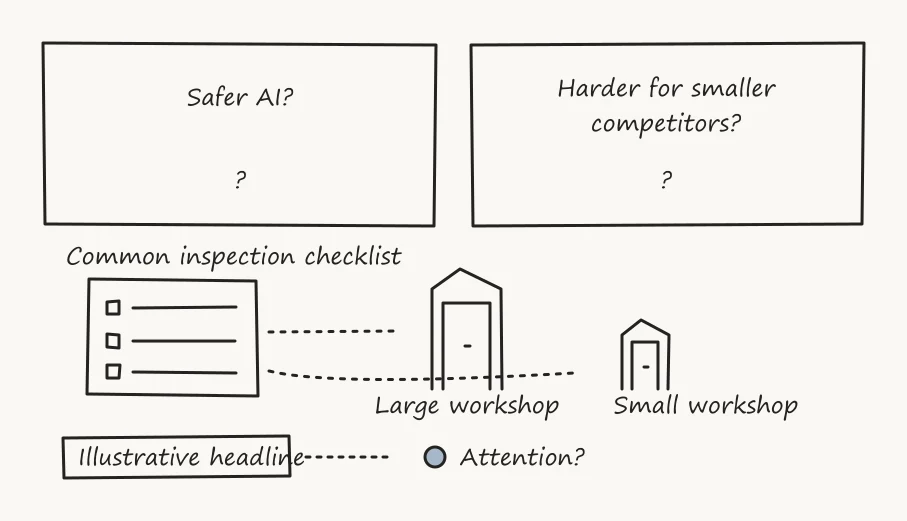
My concern about incentives remains. A warning that a company's technology is extraordinarily powerful can also make that technology sound extraordinarily valuable. That is a hypothesis about how a message might work, not knowledge of anyone's private motives.
When a powerful company asks for rules, I'd ask two questions. Will the proposed rules make AI safer? Could they also make it harder for smaller competitors to participate?
Both effects could exist. Examining the second doesn't disprove the first, and accepting a safety concern doesn't require accepting every proposed response. We need to look at the particular rule and its consequences.
Bring the decision back to the work
We can investigate future risks while making better decisions about current systems. Those responsibilities don't cancel each other out.
I've seen someone try to use a language model to help with a tax return. It can help explain and categorise things. But a reasonable-sounding return isn't necessarily an accurate one. The calculation needs an appropriate, checked tool and reliable inputs. Fluency isn't a substitute for getting the numbers right.
For a different, hypothetical example, consider an organisation introducing an assistant that answers customer questions. Its immediate governance work includes checking the information it uses, deciding what it may say or change, and providing a route to a person when it can't help. A general debate about superintelligence won't make those decisions for the team.
I'm excited about the useful things we can build with AI. I'm also concerned about what we lose if we treat it as a replacement for human relationships or judgment. We don't need to wait for a more intelligent model to take either possibility seriously.
The useful stance is to match the tool to the job, investigate the harms we can identify, and revisit our assumptions as capabilities change. Ask for the scenario, then ask what we should do differently because of it.
Adapted from the Akermoor video What If AI Doom Is a Distraction?, originally titled How Will AI Kill Us?.