

AI Is Not One Thing. So Name the Job
A practical way to turn a vague AI discussion into a clear decision about the task, the evidence, and the authority a system should have.
Ask whether a business should use AI, and you can get a lively discussion without getting much closer to a decision.
One person is thinking about a chatbot. Another means demand forecasting. Someone else wants an agent that can make changes to business systems. They're using the same word for quite different things.
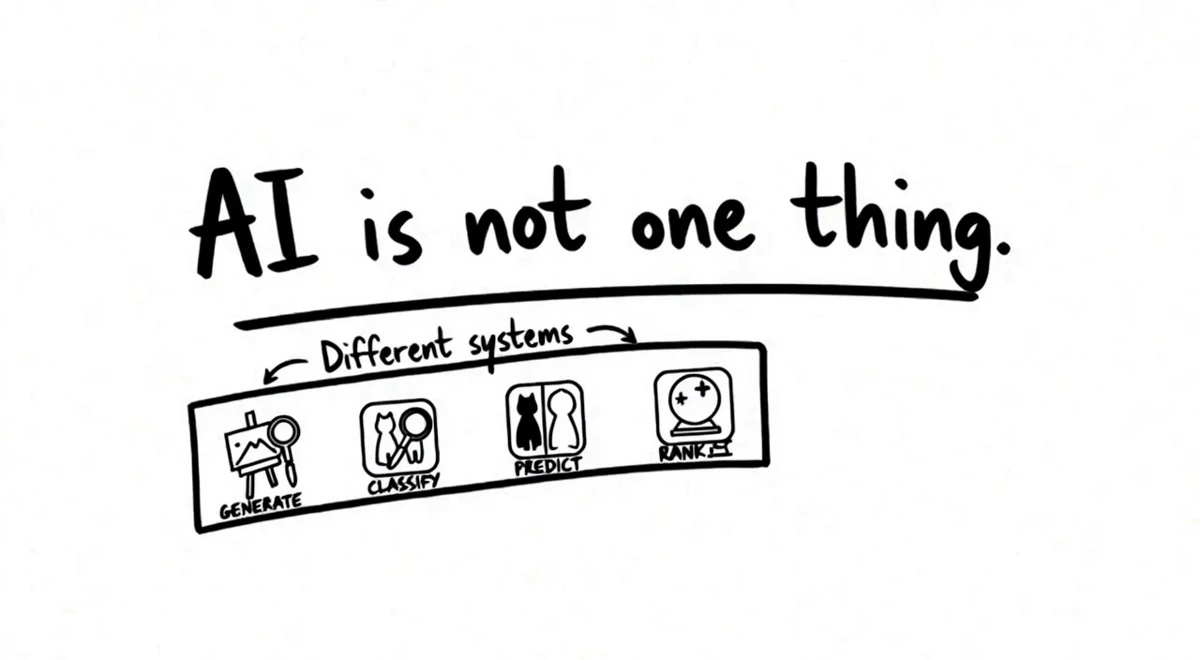
Saying we want to use AI leaves the important part of the brief unfinished. What kind of system, doing what job, for whom? I think we need to slow down at that point. Before deciding whether we trust AI, or where we should invest in it, we need to say what we're actually asking it to do.
Start with the output
Watch the illustration
Silent illustration. Use the playback controls to play or pause.
The OECD's explanation of its AI system definition distinguishes outputs including predictions, content, recommendations, and decisions. That breadth matters. Generating a paragraph is one possible job within a much wider category.
For a practical discussion, we can make the work more concrete:
- A classifier assigns a category, such as routing a support request.
- A recommender ranks options, such as suggesting which document to read.
- A generative system produces content, such as drafting a reply.
- A perception system interprets inputs such as images or sound.
- A planner proposes steps towards a goal.
These are useful descriptions of jobs, rather than neat boxes for products. A single system might combine several of them. Orchestration then connects the steps, tools, and decisions into a workflow.
That distinction changes the questions we should ask. A useful draft needs checking for accuracy, tone, and omissions. A useful routing system needs checking for misdirected requests and what happens to them. Reading a few fluent paragraphs won't tell us whether a queue is being managed well.
Follow one request through the system
Imagine a customer asking for a refund. This is a hypothetical example, but it makes the distinction clearer.
A system could categorise the request, retrieve the relevant policy, draft a response, recommend a refund, and issue it. We might describe the whole thing as an AI assistant. Yet those steps carry different responsibilities.
Drafting the explanation doesn't establish that the customer is entitled to the refund. Finding the policy doesn't establish that it's the current policy. Recommending a payment doesn't establish permission to make it.
The useful conversation is about each of those boundaries. What information is required? What could be wrong? Who checks it? What is the system allowed to change?
A good answer in a chat window is only part of that picture.
Separate capability from authority
A system's ability to perform a task and its permission to act are separate design decisions.
We might be comfortable letting a system prepare a refund recommendation while requiring a person to approve payment. We might allow routine payments within defined limits, with exceptions sent for review. Those are choices about the workflow, accountability, and consequences.
Calling something an agent doesn't settle any of them.
I'd want the team to describe the proposed system in one plain sentence: it uses these inputs to produce this result, and it can take these actions without further approval.
If that sentence is difficult to write, there's probably still a decision hidden inside the product description.
Make the disagreement specific
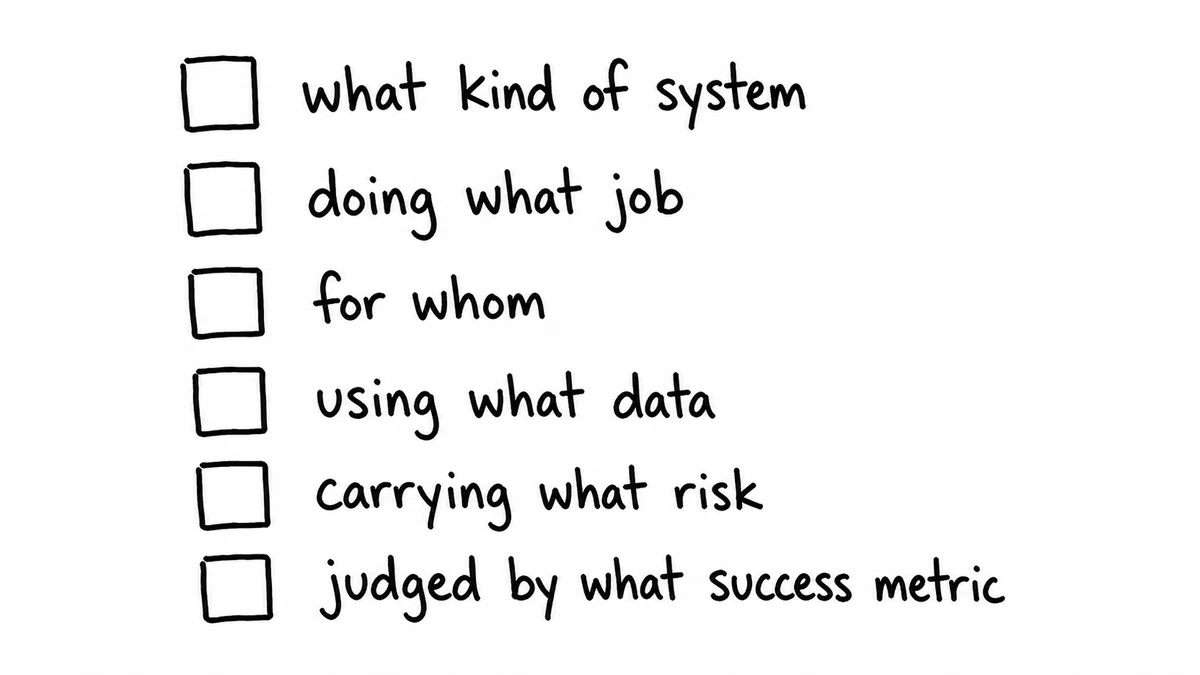
This also helps when people disagree about AI's risks or benefits. A concern about generated content may be entirely reasonable without answering a question about forecasting. A successful classifier doesn't prove that an autonomous workflow is ready to operate.
The categories don't excuse harm or make difficult ethical questions disappear. They give us somewhere useful to begin: a particular purpose, affected people, a kind of failure, and a decision about responsibility.
For the next AI proposal, I'd ask three questions:
- What job are we asking the system to do?
- What evidence would show that it's doing that job well enough?
- What authority does it need, and who owns the consequences?
Those questions won't produce a universal verdict on AI. They should produce a better decision about the system in front of us.
This article develops the business questions in my video, AI Is Not One Thing. The refund example is an illustration, rather than a client case.